Duisburg Educational Center for Waste and Water Management
Project Description
Duisburg Educational Center for Waste and Water Management
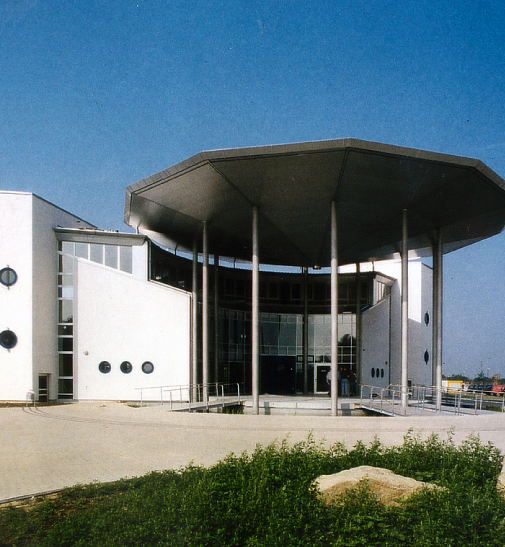
The design aims for a concise appearance that outwardly communicates its functional content. The themes of water and waste, broadly encompassing ecology and balance, are to be highlighted. Visitors enter the building by crossing one of the bridges over the water feature from the driveway. They then reach the fully glazed entrance hall, situated beneath an entrance structure supported by stainless steel columns, offering views and access to the adjacent park and water landscape. The ecological principle is also reflected in the building’s technical and structural features. Building components and materials are selected and dimensioned to exceed the thermal insulation requirements of the 1995 thermal protection ordinance, aiming for a low-energy building standard. Heat is supplied by a combination of a solar thermal system, two combined heat and power (CHP) units, and a gas-fired condensing boiler for peak loads. Electricity is supplied via a photovoltaic system (on the south facade of the workshop) and the option of a wind turbine (a horizontal rotor on the roof of the entrance building); additional electricity comes from the CHP units and the public grid. The building’s distinctive features—its clear layout (training on the left, general uses and residential areas on the right), and its bright, inviting interior design complemented by green park and roof areas—are intended to foster a sense of identification and well-being among both instructors and learners, enabling them to effectively focus on their institution’s important objectives.